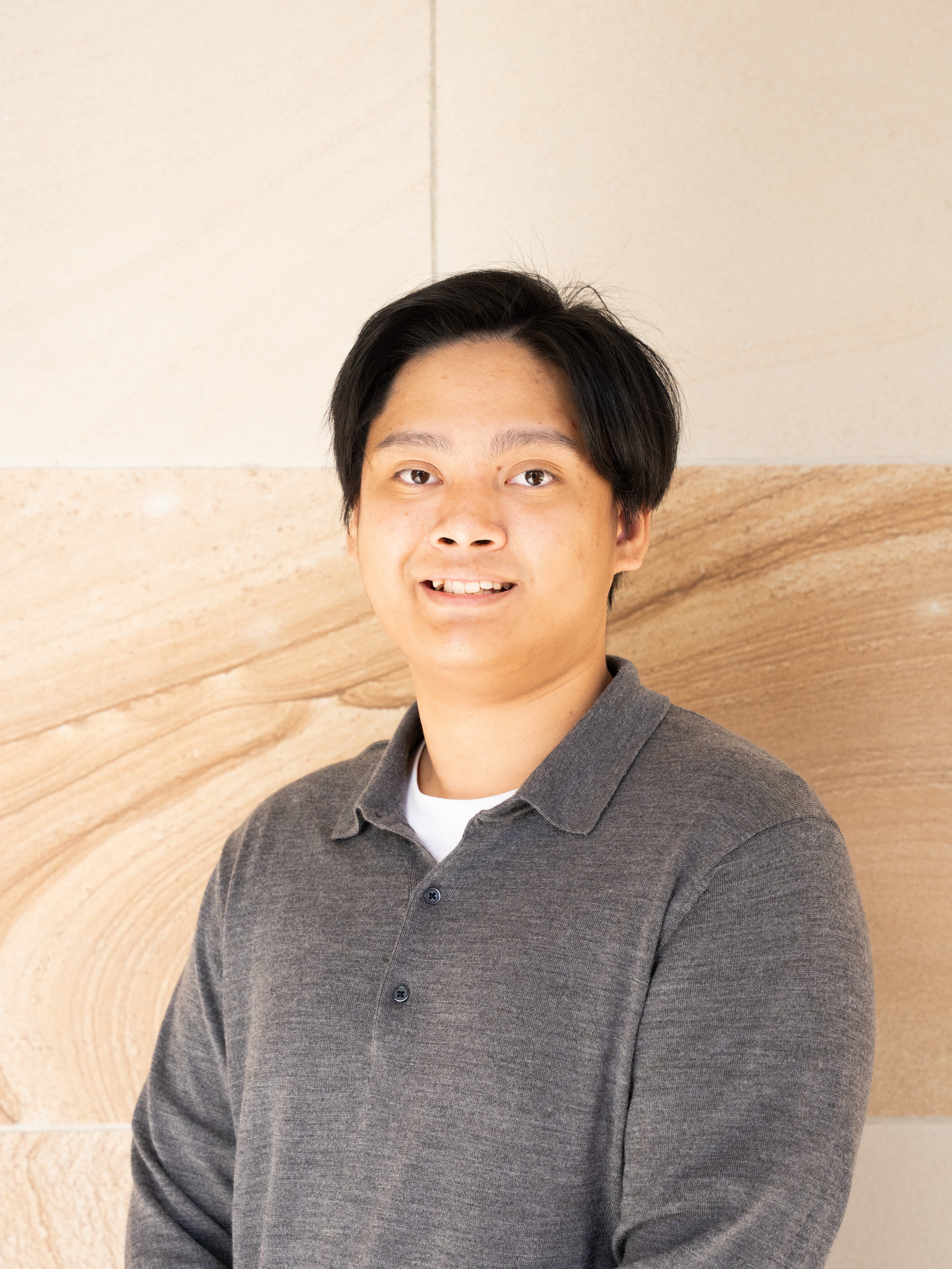
Hello, I'm

Kierren Cheng

|

Learn More

About Me

////////////////////

Kierren Cheng

Professional Events Officer | Fifth-Year Chemical Engineering and Science Student

////////////////////

I am a fifth-year Chemical Engineering (Honours) and Science student at The University of Queensland with a strong foundation in process design, simulation, and equipment sizing. I am experienced in applying mass and energy balances, process modelling, and control systems through academic and research projects. With demonstrated ability to work in multidisciplinary teams, I have a strong interest in engineering consulting across energy, water, and industrial sectors.

Additionally, I Major in Bioprocess Engineering and Microbiology with interests in bioprocessing and translational science, particularly the application of molecular virology to vaccine and diagnostic development. I am also the Professional Events Officer with the UQ Biotechnology Society, leveraging my technical expertise alongside strong stakeholder engagement and industry networking skills.

Throughout my studies, I have gained hands-on experience in virology research at the Peters Lab, focusing on chimeric alphaviruses characterization and lateral flow assay development. This research has strengthened my understanding of molecular biology techniques and diagnostic device design.

As the Professional Events Officer with the UQ Biotechnology Society, I have organized and supported major events including career panels, research and career nights strengthening my skills in event planning, stakeholder engagement, and industry networking.

I am also a team member at TacklEmission, a synthetic-biology venture part of the Australasian Synthetic Biology Challenge, engineering bionanoparticles to reduce livestock methane emissions, where I contribute across the technical and outreach sides of the project.

My experience extends to customer service as a team member in the Deli Department at Coles Supermarkets, where I've developed strong multitasking abilities and adaptability in fast-paced environments, especially throughout the pandemic, while maintaining exceptional health and safety standards.

Recently, I have been exploring web development and design, expanding my technical skillset beyond the laboratory.

//////////////////////////////

WHAT I DO

SKILLS & EXPERTISE

🔬

Microbiology

Virology research, chimeric alphaviruses characterization, lateral flow assay development, and molecular biology techniques.

👥

Leadership & Events

Event planning, stakeholder engagement, industry networking, organizing career panels and research nights.

🎓

Engineering

Chemical engineering with specialization in bioprocess engineering, and technical problem-solving.

Team Management

Fast-paced retail environment, customer service excellence, multitasking, inventory management, and team collaboration.

MY EXPERIENCE

PROFESSIONAL EXPERIENCE

Student Ambassador

Selected as one of the student ambassadors for the Ausbiotech International Conference out of 100+ applicants across Australia. Represented the biotechnology student community at Australia's premier industry event.

Biotechnology Conference

Professional Events Officer

UQ Biotechnology Society (2025 – Present). Engaged with industry representatives and academics, building relationships which create opportunities for members to explore diverse careers and research pathways within biotechnology. Organized career panels, industry nights, and lab tours.

Event PlanningNetworkingLeadership

Virology Research

Conducted research on chimeric alphaviruses characterization, investigating viral properties and behavior. Contributed to lateral flow assay development for rapid diagnostic applications, combining molecular biology techniques with practical device design.

VirologyAlphavirusesDiagnosticsAssay Development

Team Member – TacklEmission

Team member at TacklEmission, a synthetic-biology venture from the Australasian Synthetic Biology Challenge engineering bionanoparticles to reduce livestock methane emissions. Contributed across the technical and outreach sides of the project.

Synthetic BiologyBioprocess EngineeringASBC
View Website LinkedIn

MY WORK

WEB DEVELOPMENT PROJECTS

UQ Biotechnology Society Website

Designed and developed the official website for the UQ Biotechnology Society, creating an engaging platform to showcase events, connect members, and promote the society's mission. Built with modern web technologies ensuring responsive design and optimal user experience.

Web DesignFrontendResponsive
View Website

TacklEmission Website

Designed and built the investor-facing website for TacklEmission, a synthetic-biology venture engineering bionanoparticles to reduce livestock methane. Developed with Next.js, React, and TypeScript for a responsive, accessible experience, with SEO and structured data.

Next.jsReactTypeScriptResponsive
View Website LinkedIn

Peters Lab Website

Developed a professional laboratory website to showcase research activities, publications, and team members. Features a clean, academic design that effectively communicates the lab's work in virology and molecular biology research.

Web DevelopmentGitHub PagesAcademic
View Website

COURSEWORK & RESEARCH

ACADEMIC & RESEARCH PROJECTS

TacklEmission – Engineering Bionanoparticles to Reduce Livestock Methane

  • Livestock account for a significant share of global methane emissions, produced by methanogenic archaea in the rumen of cattle; TacklEmission is developing a feed additive that targets these methanogens directly using engineered biological nanoparticles.
  • Engineered a single genetic construct that builds the nanoparticle and displays the enzyme in one step, expressed in E. coli as a proof of concept.
  • Live site: tacklemission.com
  • LinkedIn: linkedin.com/company/tacklemission
Synthetic BiologyBioprocess EngineeringOperon DesignPHA NanoparticlesE. coli

Bioethanol Production Plant Design

  • Developed a preliminary concept design for a first-generation sugarcane biorefinery in Ayr (Burdekin, Queensland) to maximize local feedstock access and logistics.
  • Set the design basis at 90 ML/year total output, split into 60 ML/year anhydrous ethanol and 30 ML/year hydrous ethanol for fuel and industrial markets.
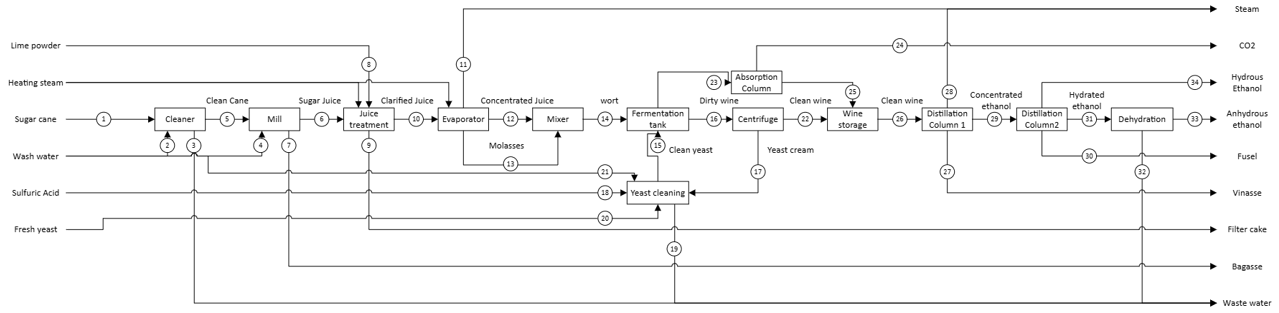
  • Designed the process train from cane pre-treatment through fed-batch Melle-Boinot fermentation, yeast recycle, two-stage distillation, and molecular sieve dehydration.
  • Defined key process performance targets including about 12 wt% fermenter wine, 95 wt% ethanol after distillation, and about 99.65 wt% anhydrous ethanol product.
  • Completed mass balance, hazard screening, and preliminary economic/sustainability assessment identifying vinasse management and distillation energy demand as primary constraints.
Bioethanol block flow diagram
Figure: Block flow diagram for the CHEE3020 bioethanol production concept.
BioethanolFermentationPFDSustainability

Acetic Anhydride Process Synthesis and Simulation

  • Applied the J.M. Douglas method to design a continuous 90 kt/year acetic anhydride plant via the acetone-ketene route.
  • Selected Texas City, USA as the plant location based on feedstock access, low natural gas costs, and industrial infrastructure.
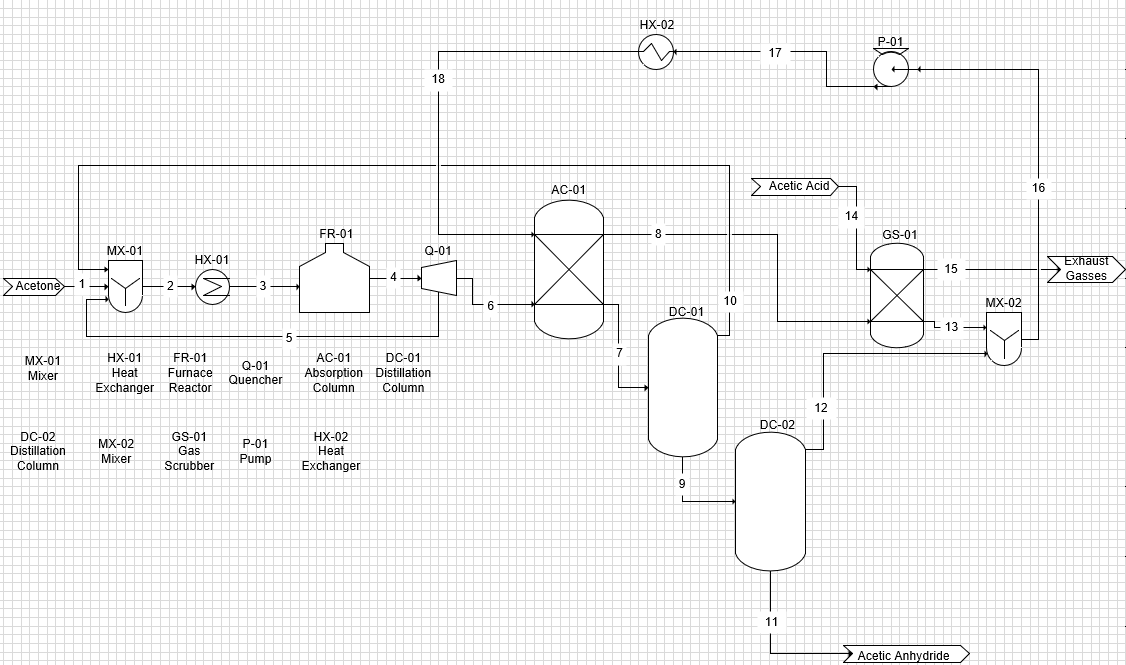
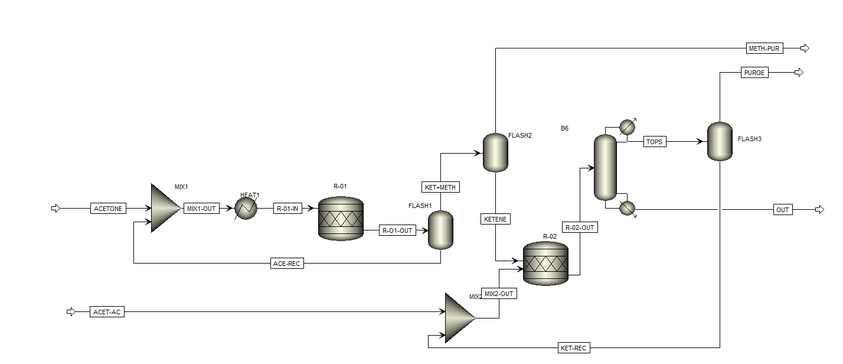
  • Developed the process flowsheet and Aspen Plus model around a furnace cracking reactor, quench, ketene absorption, distillation, and recycle loops.
  • Validated the design with a 15% single-pass acetone conversion, 99.23% product purity, and 104.08 kt/year acetic anhydride output.
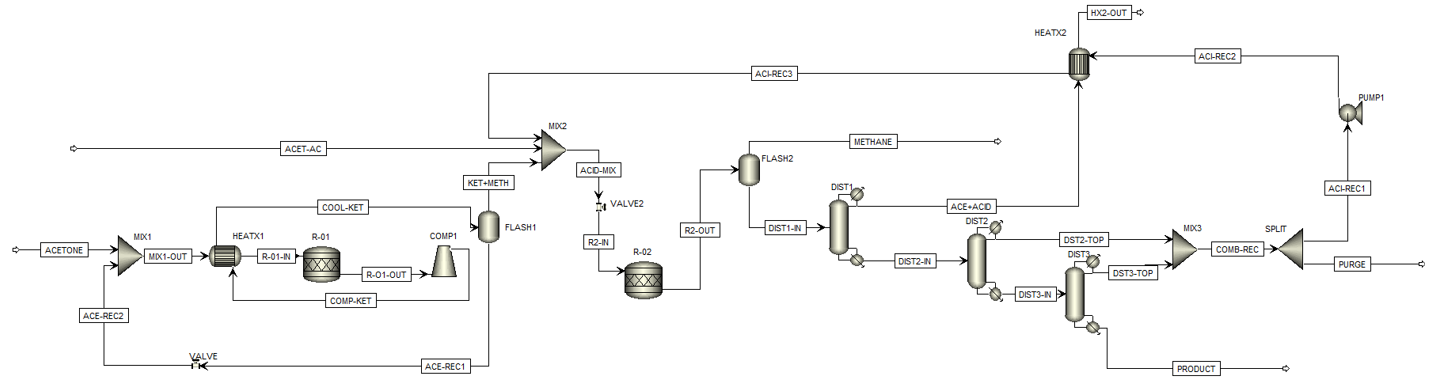
  • Integrated heat exchangers to reduce utility demand and completed an economic analysis showing CAPEX of about USD 7.8 million and OPEX of about 161 million USD.
CHEE3020 acetic anhydride process flow diagram
Figure: Process flow diagram (PFD) for the CHEE3020 acetic anhydride synthesis pathway.
Aspen model for acetic anhydride process
Figure: Aspen Plus flowsheet used to simulate the acetic anhydride process.
Heat integration for acetic anhydride process
Figure: Heat integration network implemented to reduce utility demand in the Aspen model.
Aspen PlusProcess SimulationHeat IntegrationEconomics

Heat Exchanger PID Control System Design

  • Developed a dynamic model of a shell-and-tube heat exchanger based on mass and energy balances.
  • Conducted open-loop step testing and fitted a first-order plus dead-time (FOPDT) model to experimental data.
  • Estimated model parameters using least-squares optimization in Python.
  • Designed and tuned PID controllers using Internal Model Control (IMC) across aggressive, moderate, and conservative regimes.
  • Implemented anti-reset windup (ARW) and actuator constraints to prevent saturation.
  • Evaluated feedback, feedforward, and cascade control strategies to improve disturbance rejection and set-point tracking.
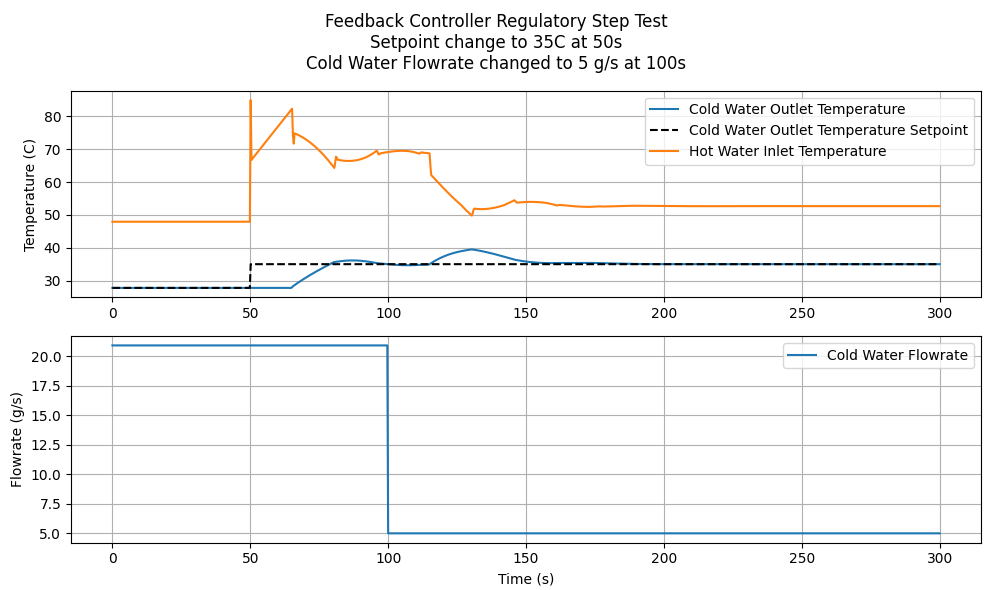
Feedback controller regulatory step test plot
Figure: Regulatory step-response test used to assess feedback controller disturbance rejection.
PID ControlIMCPythonFOPDT

Distillation Column Dynamic Model (Water-MEG)

  • Built a dynamic model of a 5-stage pilot distillation column (reboiler, three trays, and reflux drum) for separating water and mono-ethylene glycol.
  • Implemented constituent VLE functions in Python, including Antoine-based saturation pressure, equilibrium constants, relative volatility vapour composition, and isothermal flash calculations.
  • Derived and solved coupled component-balance ODEs with odeint for stage compositions under varying reflux ratio, temperature, and pressure.
  • Added numerical routines to determine the minimum reflux ratio for a target distillate composition and assess model stiffness via Jacobian eigenvalue scaling.
  • Generated transient composition profiles for distillate, trays, and base to evaluate separation performance and bottoms/distillate quality.
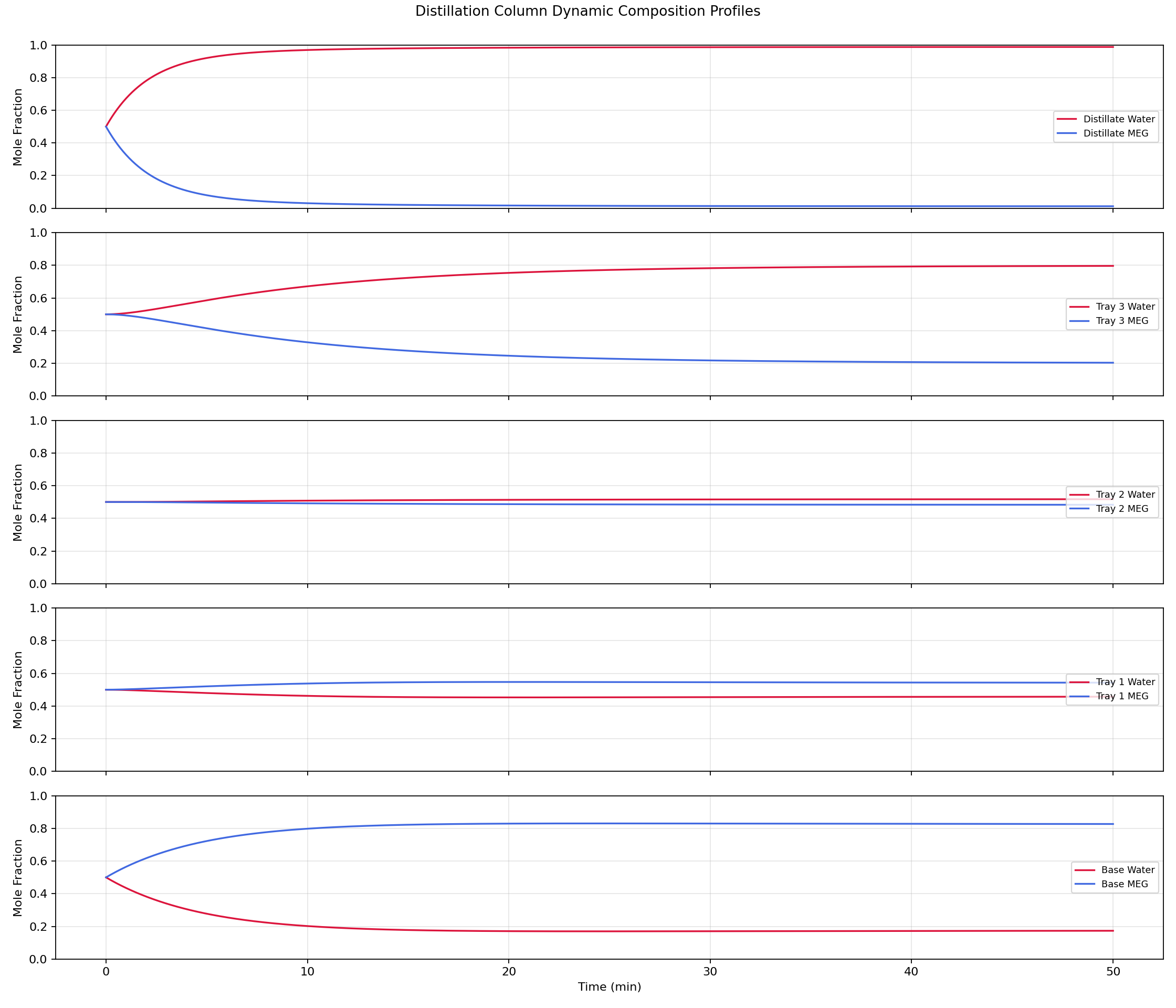
CHEE3007 distillation column dynamic composition profiles
Figure: Dynamic composition profiles across the reflux drum, trays, and reboiler.
Dynamic ModellingDistillationVLEPython

Heat Transfer Equipment Design

  • Conducted shell and tube heat exchanger thermal design by selecting an appropriate cooling fluid and determining the flowrate of the fluid required to meet process objectives.
  • Conducted shell and tube heat exchanger rating design including determining the exchanger configuration, TEMA code, number of shell and tube passes, fluid placement, tube pitch and sizing, tube bundle and shell diameter and pressure drops across the exchanger.
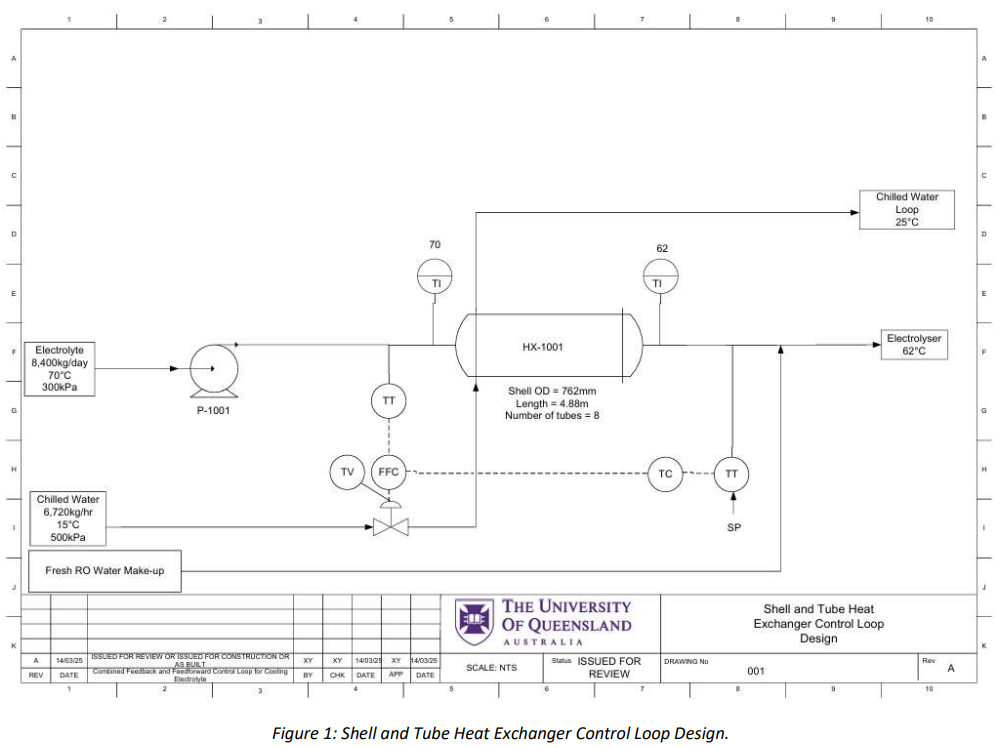
  • Completed shell and tube heat exchanger control loop design.
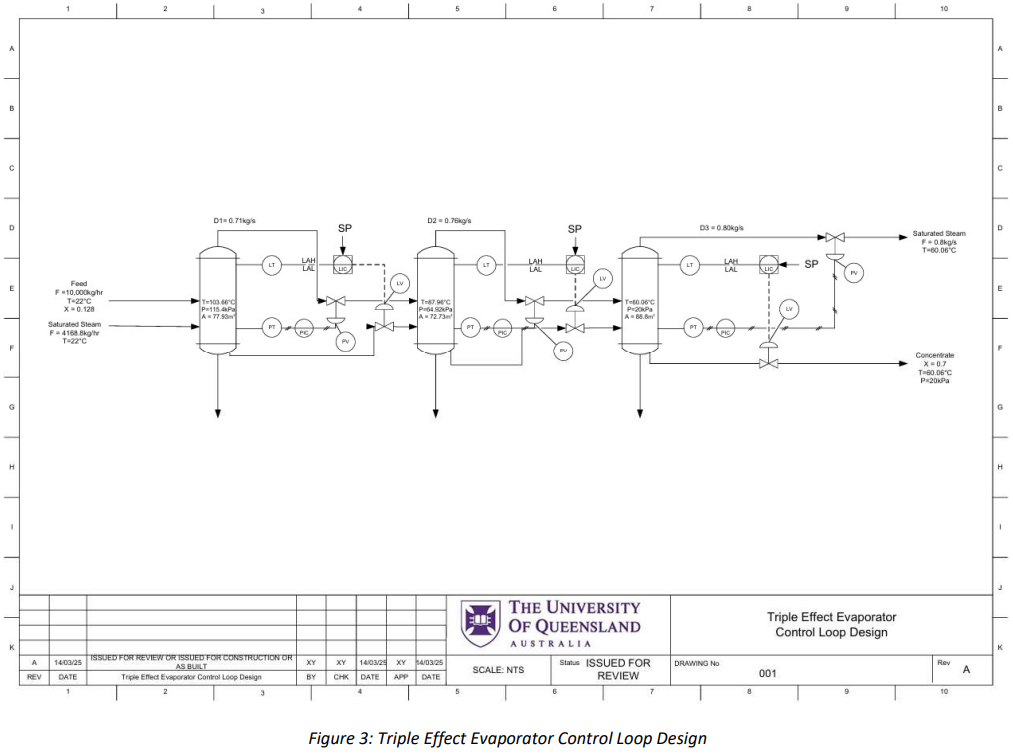
  • Completed triple-effect evaporator control loop design.
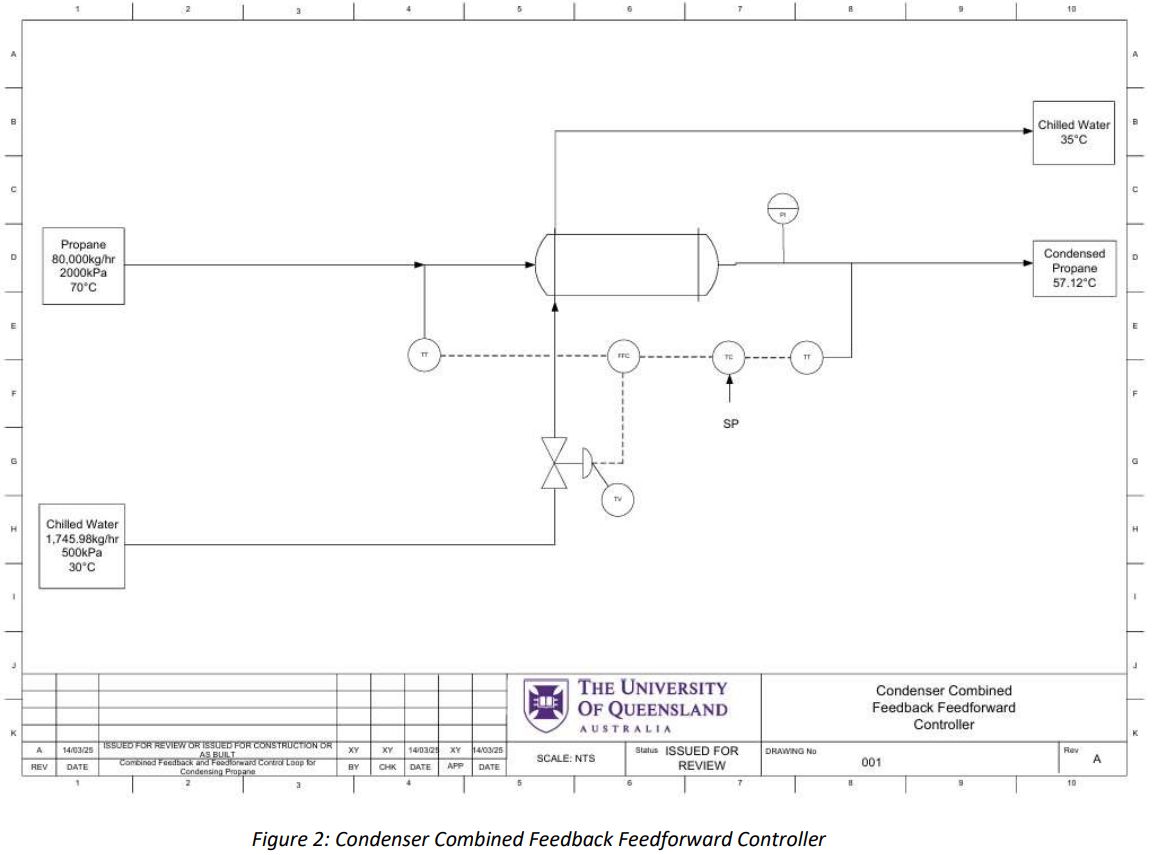
  • Designed a condenser combined feedback-feedforward controller.
Shell and tube heat exchanger control loop design
Condenser combined feedback-feedforward controller
Triple-effect evaporator control loop design
Heat ExchangerTEMAThermal DesignControl Loops

Distillation Column Design

  • Completed a mass balance and McCabe-Thiele graphical analysis for the separation of methanol-water.
  • Determined the minimum reflux ratio and operating reflux ratio, number of theoretical stages required for separation and feed stage location.
  • Determined the number of real stages and trays required to estimate column height.
  • Estimated column diameter to avoid flooding.
DistillationMcCabe-ThieleMass Balance

Group Project – Equipment Design for Instant Coffee Powder Production

  • Performed a mass balance around the instant coffee powder processing circuit to determine the flows and compositions of key streams in the circuit.
  • Identified process hazards and risks to operating staff.
  • Conducted preliminary sizing and design of key pieces of equipment and estimated energy consumption.
  • Designed and drew process control schemes for each process.
Process DesignMass BalanceSafetyControl Schemes

Antigenic Characterisation of Pathogenic and Chimeric Alphaviruses using a Novel Insect-specific Platform

  • Investigated the antigenic behavior of wild-type and chimeric alphaviruses using ELISA-based assays.
  • Cultured and infected Aedes albopictus derived (C6/36) cells.
  • Generated new virus stocks and quantified viral titers using TCID50 assays.
  • Evaluated alphavirus lateral flow assays for diagnostic applications.
VirologyELISACell CultureTCID50Lateral Flow

Development of an Alphavirus Capture ELISA for Vaccine Production

  • Developed and optimised a capture ELISA for antigen-specific quantification of alphavirus during downstream vaccine processing.
  • Cultured and maintained cells (C6/36, Vero, HEK-293T).
  • Identified the protein target of a monoclonal antibody using an immunofluorescence assay in transiently transfected HEK-293T cells.
  • Compared downstream purification methods to improve yield and purity of chimeric alphavirus preps.
  • Designed and developed website for the Peters Lab.
ELISACell CultureImmunofluorescencePurificationVaccine Production

GLP Study Plan

  • Designed a GLP-compliant 28-day repeat-dose toxicity study in Swiss mice including the study plan, amendments, deviations and a QA statement.
GLPToxicologyQuality Assurance

GCP Study Protocol

  • Drafted a Good Clinical Practice compliant Phase I protocol for a single-site Australian clinical trial.
GCPClinical TrialPhase I

Commercialisation Analysis – Combination Medical Device / Therapeutic

  • Conducted customer, market growth and competitor analysis on a combination medical device/therapeutic used for the treatment of Alzheimer's disease and glioblastoma.
  • Determined the R&D activities and regulatory requirements required for the products to be commercialized under the TGA and FDA.
  • Estimated the length and cost of R&D and trial activities used for the treatment of Alzheimer's disease and glioblastoma.
Market AnalysisTGAFDARegulatory

Production of Propionic Acid

  • Built stoichiometric core models of engineered E. coli strain producing propionic acid via the Wood-Werkman cycle and SBM operon pathways.
  • Implemented linear programming in Excel to perform flux balance analysis under aerobic and anaerobic conditions.
  • Calculated maximum theoretic yields for propionate, biomass, ATP production, and CO₂ production.
  • Compared pathway energetics, redox balance, and carbon flux distribution to explain oxygen-dependent yield differences.
  • Visualized pathway fluxes and cofactor usage to justify metabolic trade-offs between aerobic and anaerobic bioprocessing strategies.
Flux Balance AnalysisE. coliMetabolic Modelling

Proteomics Data Analysis

  • Analyzed Orbitrap MS-based proteomics datasets of aerobic vs anaerobic E. coli cultures expressing the SBM operon.
  • Applied Log2 transformation, statistical hypothesis testing, and false discovery rate correction to identify significantly differentially expressed proteins.
  • Calculated log2 fold changes and constructed annotated volcano plots to evaluate oxygen-dependent regulation.
  • Investigated expression patterns of SBM-operon enzymes and central carbon metabolism proteins.
  • Integrated proteomics with metabolomics data to explain propionate production differences and assess growth coupling.
ProteomicsMass SpectrometryVolcano PlotsMetabolomics

GET IN TOUCH

CONTACT ME